
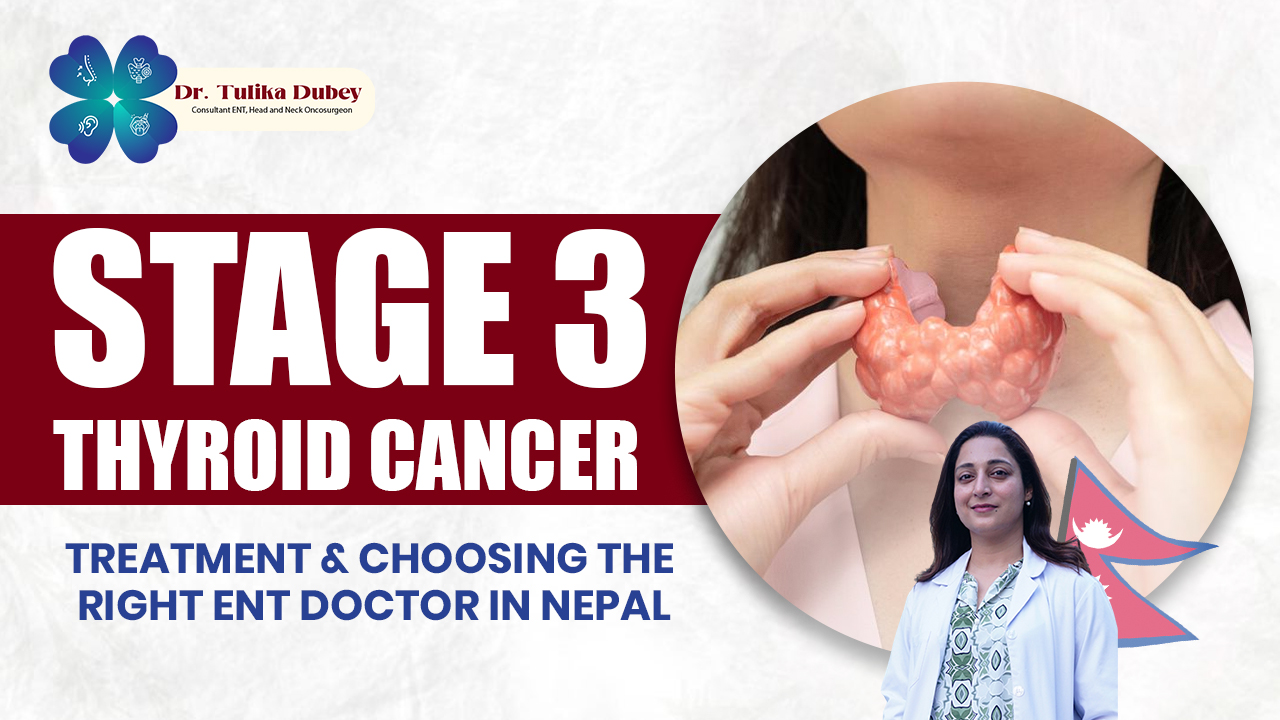
Stage 3 thyroid cancer is serious but it is still highly treatable when managed correctly and early. Many patients in Kathmandu Valley search for an ENT doctor in Nepal after discovering a neck lump, voice change, or biopsy result showing thyroid cancer.
This guide explains what Stage 3 thyroid cancer really means, how it is treated, survival outlook, and how to choose the right ENT doctor in Kathmandu or a thyroid cancer specialist in Nepal using evidence-based information only.
What Is Stage 3 Thyroid Cancer?
Stage 3 thyroid cancer means the cancer has grown beyond the thyroid gland and may involve nearby lymph nodes or tissues, but it has not spread to distant organs like the lungs or bones.
In most staging systems (AJCC TNM system):
- The tumor may be larger than 4 cm or
- It may have minimal extension outside the thyroid
- It may involve regional lymph nodes
- There is no distant metastasis
Direct definition: Stage 3 thyroid cancer is a locally advanced disease confined to the neck region. It may involve nearby lymph nodes or structures but has not spread to distant organs. With proper surgery and follow-up therapy, outcomes remain favorable in most patients.
How Serious Is Stage 3 Thyroid Cancer?
The word “stage 3” sounds frightening. However, thyroid cancer behaves differently from many other cancers.
Survival Outlook
For differentiated thyroid cancers (papillary and follicular types):
- 10-year survival rates remain high (often above 80–90% depending on age and risk factors)
- Outcomes are better in patients under 55
- Proper surgery and radioactive iodine significantly improve disease control
An experienced thyroid cancer specialist in Nepal understands that stage alone does not determine outcome. Age, tumor subtype, lymph node burden, and molecular features matter.
Symptoms of Stage 3 Thyroid Cancer
Some patients experience symptoms, while others are diagnosed incidentally.
Common signs include:
- Persistent neck lump
- Enlarged lymph nodes
- Voice hoarseness lasting more than 2–3 weeks
- Difficulty swallowing
- Breathing discomfort
- Neck tightness
If hoarseness or a neck swelling persists beyond two weeks, consultation with an ENT doctor in Kathmandu is strongly recommended.
How Stage 3 Thyroid Cancer Is Diagnosed
A structured diagnostic pathway is essential.
Step 1: Clinical Evaluation
An experienced ENT doctor evaluates:
- Size and mobility of thyroid mass
- Lymph node involvement
- Voice changes (possible nerve involvement)
Step 2: Ultrasound
Neck ultrasound helps determine:
- Tumor size
- Lymph node spread
- Suspicious features
Step 3: FNAC (Fine Needle Aspiration Cytology)
Confirms malignancy.
Step 4: Cross-Sectional Imaging (If Needed)
CT scan or MRI may be used to assess local extension.
Step 5: Staging
The final stage is determined after surgery using pathology findings.
An experienced ent doctor in Nepal should coordinate this entire pathway rather than ordering fragmented tests.
Treatment of Stage 3 Thyroid Cancer
Treatment usually involves multiple steps. The goal is cure and long-term disease control.
1. Surgery (Primary Treatment)
Surgery is the cornerstone of treatment.
Most patients require:
- Total thyroidectomy (removal of entire thyroid gland)
- Central neck lymph node dissection
- Lateral neck dissection (if lymph nodes are involved)
Surgical expertise matters significantly in stage 3 disease because:
- The tumor may be close to the vocal cord nerve (recurrent laryngeal nerve)
- Parathyroid glands must be preserved
- Lymph node clearance must be adequate
Complication rates are lower when performed by trained high-volume thyroid surgeons.
2. Radioactive Iodine (RAI) Therapy
Often recommended after surgery for stage 3 disease to:
- Destroy microscopic remaining cancer cells
- Reduce recurrence risk
- Improve long-term survival
Not every patient requires the same RAI dose. Treatment must be individualized.
3. Thyroid Hormone Suppression Therapy
After thyroid removal:
- Patients require lifelong levothyroxine
- TSH suppression reduces recurrence risk
Monitoring includes:
- TSH levels
- Thyroglobulin levels
- Periodic imaging
4. Advanced Therapies (When Required)
Rarely, if cancer shows aggressive features:
- Targeted therapy
- External beam radiation
These decisions require multidisciplinary coordination.
What Makes Stage 3 Surgery Complex?
| Factor | Why It Matters |
| Lymph node involvement | Requires extensive neck dissection |
| Nerve proximity | Risk of voice changes |
| Large tumor size | Technical difficulty increases |
| Previous biopsy scarring | Makes surgery more challenging |
This is why choosing the right ENT doctor in Nepal is not just preference it is critical for outcome.
Choosing the Right ENT Doctor in Nepal for Stage 3 Thyroid Cancer
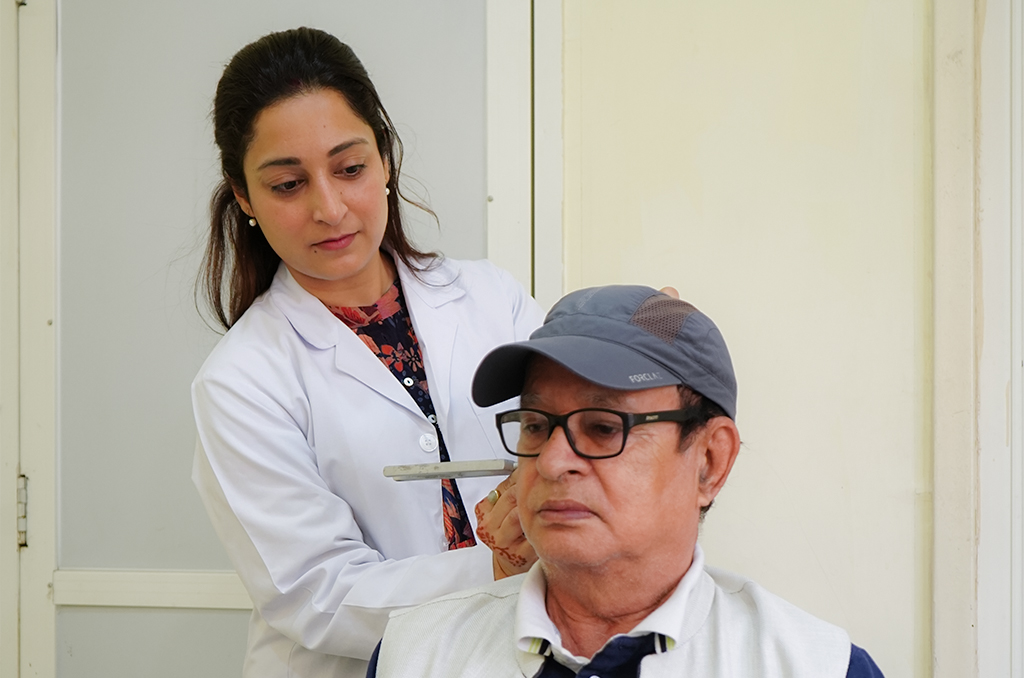
Not every ENT specialist performs complex thyroid cancer surgery regularly.
When evaluating an ent doctor in kathmandu, consider the following:
1. Formal ENT Surgical Training
Board-certified ENT specialist with advanced thyroid and head & neck surgery exposure.
2. Experience in Thyroid Cancer Cases
Ask:
- How many thyroid surgeries are performed yearly?
- Experience with lymph node dissections?
- Experience handling nerve involvement?
3. Multidisciplinary Access
Stage 3 patients may require:
- Nuclear medicine (RAI)
- Endocrinology
- Oncology support
4. Clear Follow-Up Protocol
A structured follow-up plan should include:
- TSH monitoring schedule
- Thyroglobulin testing
- Imaging intervals
About Dr. Tulika Dubey
Dr. Tulika Dubey is an ENT and Head & Neck Oncosurgeon based in Kathmandu Valley. Her background includes:
- MS ENT–Head & Neck Surgery
- Fellowship training in Head & Neck Oncology
- Experience in thyroid and neck cancer surgeries
- Consultant role in tertiary care setting
Her training in head & neck oncology is particularly relevant for advanced thyroid cancer involving lymph nodes.
Recovery After Stage 3 Thyroid Surgery
Patients often ask:
How long is recovery?
Typical recovery timeline:
- Hospital stay: 2–4 days
- Drain removal: 2–5 days
- Return to light activity: 1–2 weeks
- Full recovery: 4–6 weeks
The voice may feel slightly altered temporarily. Permanent voice complications are uncommon when surgery is done carefully.
Risk of Recurrence
Stage 3 disease carries moderate recurrence risk compared to early stages.
Risk depends on:
- Number of lymph nodes involved
- Tumor subtype
- Margins
- Age
Long-term follow-up is essential.
Long-Term Monitoring Plan
After treatment:
- TSH every 3–6 months initially
- Thyroglobulin levels as tumor marker
- Ultrasound annually
- Whole-body scan if indicated
Good long-term control depends more on follow-up discipline than initial fear.
When to Seek Immediate Evaluation
See an ENT doctor in Nepal urgently if you experience:
- New neck swelling
- Progressive hoarseness
- Difficulty breathing
- Sudden voice weakness
- Rapid lymph node growth
Common Questions (FAQ)
1. Is Stage 3 thyroid cancer curable?
Yes, many patients achieve long-term remission with proper surgery and RAI.
2. Does Stage 3 mean cancer has spread everywhere?
No. It usually means local spread within the neck only.
3. Is surgery risky?
All surgeries carry risk, but experienced thyroid surgeons significantly reduce complications.
4. Will I need lifelong medicine?
Yes. After total thyroidectomy, thyroid hormone replacement is lifelong.
5. Can I live a normal life after treatment?
Most patients return to normal life with regular follow-up.
6. Should I see a general surgeon or ENT specialist?
An ENT doctor in Kathmandu with thyroid cancer experience is often preferred for complex neck disease.
Evidence-Based Perspective
Thyroid cancer has one of the highest survival rates among solid cancers when treated appropriately.
However:
- Inadequate initial surgery increases recurrence.
- Delayed referral worsens surgical complexity.
- Structured follow-up improves outcomes.
Choosing the right thyroid cancer specialist in Nepal ensures proper staging, complete surgery, and organized monitoring.
Final Takeaway
Stage 3 thyroid cancer is not a death sentence.
It is a condition that requires:
- Accurate diagnosis
- Skilled surgery
- Evidence-based follow-up
- Long-term monitoring
If you are searching for an ENT doctor in Nepal for thyroid cancer care, prioritize surgical experience, oncology exposure, and clear follow-up planning over marketing claims.
Early action and informed decisions significantly improve outcomes.